
I-AM Global Macro Convexity Fund
Focus on convex payoff profiles
The I-AM Global Macro Convexity Fund follows a discretionary macro strategy and will invest in a variety of different risk factors and asset classes through derivatives. The focus will be on convex payoff profiles.
"The use of tailor-made derivatives permits risk profiles that should lead to stable performance in turbulent times."
Thomas Wihan, Senior Fund Manager
Convex positioning
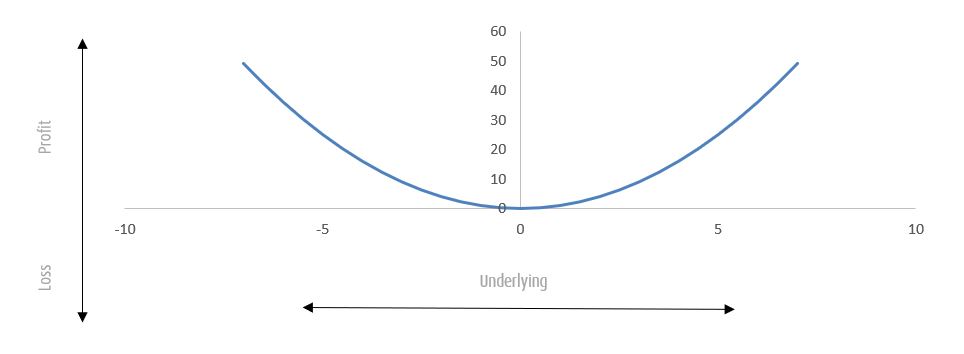
- Limited loss potential (the invested premium).
- In periods of stable markets, the fund may invest segments of its assets in products that benefit from the passage of time, e.g. currency carry trades that compensate the time decay of options.
- Positioning through long options usually saves the fund from becoming a forced seller during market disruptions.
Focus on three overarching investment objectives
Absolute return - Generating returns regardless of market conditions through a balanced portfolio (balanced "risk on", risk off" and market-neutral positioning).
Low or even negative correlation to traditional assets intended - The broad investment universe (equities, currencies, interest rates, credit as well as their volatilities and correlations) ensures exposure to a large number of risk factors and thus a high degree of diversification.
Risk-reducing potential - By actively taking long volatility positions, the fund can offer a portfolio-stabilising effect in asset allocation and thus replace different hedging approaches at low cost.
"Risk on - Risk off" and market-neutral trades
Asymmetric risk profiles, such as the purchase of options, allow the fund to profit in the event of large market movements, with risk limited to the option premium. This makes it possible to generate returns even in uncertain times, as the positions benefit disproportionately from their sensitivity to the increase in volatility and provide a stabilisation of performance. On the other hand, interesting long-term investment opportunities, such as yield curve steepening or high-yield currencies, are added to the portfolio as strategic positions. These should provide a base return.
In the portfolio construction, attention is paid to balance - "risk on", "risk off" and market-neutral positions should balance each other out. Tail risk positions are added to the portfolio to achieve the lowest possible correlation to traditional asset classes. The aim of this approach is to absorb the losses of "risk on" positions in the event of market turbulence. This structural long volatility positioning should work particularly well in times of market disruption and is applied across all asset classes.
"The fund strategy requires a risk management approach at the individual position level. This requires an understanding of the individual risk drivers and their evolution over time."
Marko Milovanovic, Senior Risk Manager
Rechtlicher Hinweis
Diese Marketingmitteilung dient ausschließlich unverbindlichen Informationszwecken und stellt weder ein Angebot oder eine Aufforderung zum Kauf oder Verkauf von Fondsanteilen dar noch ist sie als Aufforderung anzusehen, ein Angebot zum Abschluss eines Vertrages über eine Wertpapierdienstleistung oder Nebenleistung abzugeben. Dieses Dokument kann eine Beratung durch Ihren persönlichen Anlageberater nicht ersetzen. Jede unautorisierte Form des Gebrauches dieses Dokumentes, insbesondere dessen Reproduktion, Verarbeitung, Weiterleitung oder Veröffentlichung ist untersagt. Der Ersteller dieses Dokumentes sowie mit ihm verbundene Unternehmen schließen jede Haftung für die Richtigkeit, Vollständigkeit oder Aktualität der enthaltenen Informationen und geäußerten Meinungen zur Gänze aus.
Bitte beachten Sie: Eine Kapitalanlage in Investmentfonds unterliegt allgemeinen Konjunkturrisiken und Wertschwankungen, die zu Verlusten - bis hin zum Totalverlust des eingesetzten Kapitals - führen können. Es wird ausdrücklich auf die ausführlichen Risikohinweise des Verkaufsprospektes verwiesen.Grundlage für den Kauf von Investmentanteilen ist der jeweils gültige Verkaufsprospekt, die wesentlichen Anlegerinformationen ("BIB"), die Satzung des Fonds sowie der Jahresbericht und, falls älter als acht Monate, der Halbjahresbericht. Diese Unterlagen stehen dem Interessenten bei der jeweiligen Kapitalanlagegesellschaft kostenlos in deutscher Sprache zur Verfügung.
Anteilsklassen in Fremdwährungen bringen ein zusätzliches Währungsrisiko mit sich, die Performance kann infolge von Währungsschwankungen fallen oder steigen.